Showing posts with label TOS Review Crew. Show all posts

Knowledge Quest - Sacagawea - A Book Review


Knowledge Quest began in 2001 by a homeschooling family, The Johnsons.  They have 6 children and wanted to fill the holes that they saw in their homeschool curriculum choices.  The main one being maps that their children could label and color in as they studied American and World Geography.  Since then, they have had the privilege of working with numerous authors to bring other exciting resources to homeschooling families.  You can read more about Knowledge Quest here.

My family and I had the pleasure of reading one of their newest books (on our Kindle), Sacagawea by Karla Akins.  We had some familiarity with the character of Sacagawea from a few books we had read and also seeing the Night at the Museum movies.  But those don't really tell her story. 
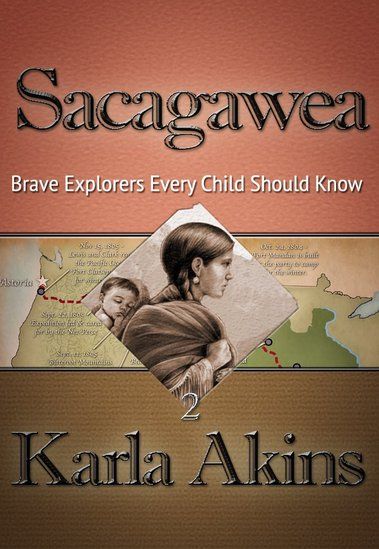
Not much is known about Sacagawea and so Karla has taken some literary license when writing this book.  However, I really felt connected as we read the book.

It starts of with Sacagawea and her son Pompey.  Her son seemed to be around 5 years old or so and he wants her to tell him stories of the past.  Mainly the Man with Red Hair.  You can tell that Sacagawea loves her son immensely and even though he has heard the story many times she tells it again.  Thus begins the journey of Sacagawea.

The book talks about how she and her sister were kidnapped from their family and wound up being slaves.  They stay slaves for several years.  Then they are both won as bets of a game and become the brides of a Frenchman.  It is here that she meets Lewis & Clark.  Clark is the Man with Red Hair. 

Sacagawea goes along as their guide to be able to talk to her people, who haven't seen her since she was kidnapped, so that they can buy horses.  She is THRILLED to be able to go home to see her family and to show them her son, Pompey. 

Imagine, just having a baby and going on a long journey.  But it's not like today.  They walked, boated, canoed, camped out without all the amenities we have today.  They got blisters, infections, attacked by bears and so much more!  Snow, rain, hail were all in this trip.  It was not an easy thing for a new mom (and baby) to endure.  But she did.  She did it for the love of her family.  The thought of seeing them again kept her going.

I will admit that at points I was crying.  I know what it's like to be away from family.  But I at least had some say in that.  Sacagawea did not. 

I don't want to give much more away, but I will say that we really enjoyed the book.  Jonathan (11) was definitely able to understand what was going on and enjoyed hearing some of the journal entries from Lewis & Clark.  Jordan (5) seemed to like Pompey quite a bit.  He would keep asking about the little boy in the book. 

The book is very well written and not hard to read.  I even had Jonathan read a chapter a day so I could see what all he would remember about it. 

I felt so emotional as Sacagawea grows up through this book.  From a young girl to a teenager and then a wife and mother.  She works hard and never gives up.  Even when life threw everything at her, she keeps going.  It was only during extreme illness that she stops for a moment (or so it seems).  The emotional tugs as a mother got to me as well.  She would do anything to protect her child.  She also wanted the best for her child. 

She struggles for her identity, especially since she is not like the "white-man".  She learns to stand up for herself and her son and ultimately wants to be known as an equal.  Especially since she works so hard for everything. 

I think that Sacagawea is a definite book to have in your library.  You will definitely be able to connect to her character.  It is something that the whole family can enjoy.  I know mine did.

Sacagawea is available here for $3.99


Photobucket


 photo DisclaimerGraphic1_zpsf612f371.gif
Read More

Leadership Garden Legacy - Review


Leadership Garden Legacy was created by Debra J. Slover.  She is a graduate of Oregon State University and has more than 27 years experience in training and empowering youth and adult leaders.  Debra's story is shared in the book U.N.I.Q.U.E. Growing the Leader Within.  But you can also read about her here.  It was through her life experiences that she chose to help others develop their leadership skills.

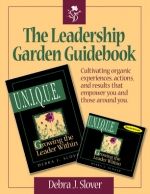
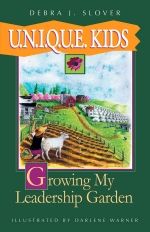
There are 2 main books.  The book for adults - U.N.I.Q.U.E. Growing the Leader Within & the book for children - U.N.I.Q.U.E. Kids Growing My Leadership Garden (10+).  There is also a guide book for the adults and an activity book for children is in the works.  The books are also available in MP3 format for those who are on the go!  (This was very useful to us!)

So, Jonathan and I received our books in the mail and our downloads for the MP3's of the books to take with us.  We also got the guidebook and a prototype for the activity book for children.  I assigned reading time for us together as we worked through these books.  This way we would be basically going through the same thing but at our own levels. 


As I read Debra's story in the adult book, Growing the Leader Within, I was crying.  I can't even imagine the pain she went through.  But it helped shape her and give her experiences to learn from that brought her to where she is today.  This story is not in the child book.

Both books use the same acronym U.N.I.Q.U.E.  This stands for Understanding, Nurturing, Inventive, Quality, Unstoppable, Expression of Leadership.  Debra uses the setting of a farm to help go through the 6 characteristics of a leader. 

The main character of the book is Hugh.  He is a sheep who has lost his way.  He also has to deal with a lot of seeds that he let take root in his mind, heart and spirit.  Things that weigh him down.  But he meets Leda, one of the owners of the farm and she decides to take him home with her and help him plant his Leadership Garden.  There he meets Annabelle and she goes through the 6 leadership garden lessons.  Each one has something different to be learned.

As an adult going through Growing the Leader Within, I realized how much like Hugh I was.  All the negativity and thoughts that I had let take root in my mind, heart and spirit.  It is enough to weigh a person down so much they feel like a failure.  It is hard to overcome those things without guidance.  And that's what this book does.  It guides you through 6 different lessons with different activities to do to help you grow as a leader and pull the weeds of doubt and negativity. 

I really liked how the activities at the end of each chapter really helped nail home the lesson that was being taught.  You definitely need the guidebook as it is referenced quite a bit.

For the kid's book, Jonathan (11) would read a chapter or 2 a week and answer the questions at the end.  Not every chapter had questions though.  We also got to use the activity guide and journal for the kids book.  The book follows the same story of Hugh and his journey through the leadership garden.  But this is definitely geared toward a younger mind. 

You could definitely read this aloud to younger children or listen to the audio version.  I would definitely recommend it.  Jordan (who turns 6 in a month) would sit and listen to the audio during play time.  Granted he didn't listen 100% of the time, but I was able to ask questions and he would often be able to give me an answer.

We also used the audio MP3's when we would be in the car.  It is a great way to get it in.  Jonathan was able to follow along with the book while listening to the audio.

I really liked being able to incorporate some of the activities from the kids activity guide.  It not only deepens the lessons but also is a good way to incorporate school type activities without being to invasive. 

Jonathan is my writer, so the journal really appealed to him.

Overall, I am really pleased with these books.  I could call them curriculum, but it's actually a type of self-help and guidance.  They guide parents through their own leadership path and also help guide the parents to nurture their own children through the leadership garden.  I think in this day and age where we are going to be in need of good Leaders, this will go a long way in helping parents and children realize their full potential.

Pricing for the Leadership Garden Materials is as follows:
U.N.I.Q.U.E: Growing the Leader Within - $18.95
U.N.I.Q.U.E Kids: Growing My Leadership Garden - $18.95
The Leadership Garden Guidebook - $18.95
U.N.I.Q.U.E. Kids Activity Guide & Journal (Download) - $8.95
U.N.I.Q.U.E. Kids Audio MP3 (Download) - $ 8.95
U.N.I.Q.U.E.: Growing the Leader Within Audio MP3 (Download) - $14.95


Photobucket


 photo DisclaimerGraphic1_zpsf612f371.gif
Read More

ABeCeDarian - REVIEW


The ABeCeDarian Program was written by Michael Bend, Ph.D.  It was created to help develop students into fluent readers.  ABeCeDarian is "a research-based, explicit, comprehensive, multi-sensory decoding program."  To read more about the author, Michael Bend, click here.  To read more about the program details click here.

When I taught my oldest son, Jonathan, to read, the program was the same that I had when I was a child.  It was good and he learned a lot, but we didn't have fun or enjoy it.  It was very phonics oriented, which isn't a bad thing and it worked for Jonathan, but I knew that Jordan(5), our 2nd son, was a completely different child with a different style of learning.  He is more hands on and needs a different approach to learning to read.

ABeCeDarian is definitely different then your typical phonics based reading program.  Now there is nothing wrong with a phonics based program, but as we tried to implement that early on in the school year, I could see it would be a struggle for us.  Jordan just learns different.

When we received our package from ABeCeDarian I started reading the teachers guide for level A1.  A1 is for Kindergarten to 1st grade readers who may be struggling.  There is a good bit of reading on the teacher's end to completely understand the program and how it works and the best way to implement the program.  In going through the teachers guide, I really liked how they implemented the skills necessary to read.  It is a completely different approach than what I had used before with Jonathan.  It reminded me of the Charlotte Mason teaching style.

One of the things that was different and opposite of what I had been doing with Jordan was teaching letter names and the sounds together.  In ABeCeDarian they teach the names after the students have learned all of the sounds.  I think this offers less confusion for student.

They also do not teach sight words.  And honestly, in going through the program, I don't think that we will need to do sight words at all.  This program is very effective in it's teaching methods.

One of the methods they use is the Tap-and-Say.  Tap-and-Say was probably the best thing for him.  You tap each letter, say the sound (not the letter) and then put the sounds together.  Something else in this curriculum is word puzzles.  These are fun little games that involve solving the puzzle by figuring out the sounds in the word.  (More detail on this in the teachers manual for this)

I will admit that when Jordan first started, he was hesitant.  It was different than what we had been doing and he can be very resistant to change.  But once he saw how hands on this was going to be he started to warm up to the program.

Jordan and I would begin our day with ABeCeDarian.  We received the Curriculum that begins with level A1 and goes all the way through B1.  I chose to start him in A1 and work our way up through the curriculum.  Even if was a slight review, I wanted him to get used to the methods we were using in the curriculum. 

The lessons started with the Word Puzzle for a short word.  This helped him figure out letter sounds and how to put the letters in the correct order.  He really liked solving the puzzle.  Then we would work on Tap-and-Say for our words we had just completed using the puzzle.

But those 2 things aren't the only things used.  They also incorporate handwriting.  Writing each sound and then the whole word.  These activities all work together to help solidify each thing learned for the day. 

We would spend about 30-45 minutes total working through all of these activities.  Some days actually go very quickly because he is actually enjoying learning to read.  He has even brought over some simple books to try and read to me.  I am really thrilled that he is wanting to learn more. 


I still kept to doing 1 lesson a day 4 days a week.  I know he could do more, but I don't want to rush him through the process.  I want him to fully grasp each concept and set of sounds.  I think if we did more than one lesson in a day, things would blur together and he wouldn't get a complete understanding of what is being taught.

To say that Jordan and I are happy with this curriculum would be an understatement.  I am thrilled that he wants to learn and will actually bring me our books each day.  He is already learning so much and putting things together very quickly now.  This is something that motivates him.

The program we used and are almost finished with was A1.  The Pricing for ABeCeDarian A1 is as follows.

Teacher's Manual - $28.50
Student Workbook -  $12.25

I believe this program is a great reading program.  It is fun and engages the child.  My son comes back wanting to learn more.  He is excited to learn.  What a blessing for our family.  I can't wait to use it with our other children as well.  (though I will need to purchase more workbooks, but completely worth it in my opinion) 


Photobucket

 photo DisclaimerGraphic1_zpsf612f371.gif


Read More

Computer Science For Kids - Review


Computer Science For Kids products are written by Phillip Conrad and Lou Tylee.  The companies KIDWARE & Biblebyte Software were started in 1982 in an effort to present "family-friendly" learning games for kids.  You can read more about the authors here and the company background here.

KIDWARE Software publishes computer programming tutorials for schools, homeschools and computer enthusiasts.  They have tutorials for Microsoft® Small Basic, Visual Basic®, Visual C#®, and  Oracle JavaTM . Their products are geared toward middle (5-8) and high-school students.

We were able to choose between Computer Bible Games with Small Basic or Beginning Microsoft Small Basic for our review.  So I asked what Jonathan (who is turning 11 in a week) wanted to study and he chose Computer Bible Games.  It allows the Christian middle school student to study Microsoft Small Basic while creating a fun but yet simple game.

When I got the tutorial downloaded, I printed it off.  Be sure to have a whole ream of paper and print on both sides.  The tutorial is about 400pages long.  I also printed it in draft to save ink.  But be sure to leave it in color so you can see the different text colors for Small Basic text in the window.  Definitely something that is important when writing Small Basic script.

I would read the chapter he was working on ahead of time so I would know what he was about to do in the course and also because I am a computer geek!  I was actually very excited that computer classes come up for the Review Crew! 

So we would spend about an hour to an ninety minutes a day approximately 3 days a week working through each chapter.  Other than the installing of Small Basic Program (which is described in one of the first chapters), I have him work through steps a couple of times to get the hang of the Small Basic computer language.

To me it's not that hard, but I have a bit more experience than Jonathan.  He would ask a few questions and I would explain the best I could.  I also got daddy involved as he is also a computer geek. 

I can really see Jonathan was enjoying himself as he learned more about computers and their programming.  He is so excited that when he is done with this course.  We try to do one lesson a week.  I really keep him at that pace as I don't want him to rush through and miss any steps.  Any step that goes missing could significantly alter the outcome of the final product.  He double and even triple checks his work and we go over it together. 

Each chapter can be anywhere from 20 - nearly 100 pages.  So it definitely takes the full hour each class to work through.  Like I said above, I typically schedule 3 days but if the chapter seems particularly long then I will schedule 4 days.  But we have been able to stick to the 3 days a week for the most part.

As a parent and teacher, I really like how this curriculum is put together.  It covers every step, from installing the software to color selections for the program.  They explain things in ways that are simple enough for middle school and high school students to grasp and be able to follow as they work through the lessons.  It is very thorough and explanatory.

There are 13 chapters (lessons) to work through in this course.  We are about half-way through it right now and Jonathan is loving it.  Each step closer to the finished project he gets more excited. 

Computers and more importantly computer technology is going to be a very important part of the future.  By giving our children access to technology and training them how to understand and use it is an important skill to have today.  It will be a valuable asset to them.

Computer technology was something my own father told me to go to college for, and while I really wanted to major in music, I listened to him.  He was right!  Computers are everywhere.  That phone you have, it most likely has a computer in it.  Especially if it's a "Smart-Phone".   

Overall, I would definitely recommend this course to any homeschooling family.  It is perfect for the child who wants to learn more about computer program writing.  My son loves it. 

We will be updating with some screenshots of our finished program soon.  :) 

My son and I received the Single User License Digital e-Book download for Computer Bible Games with Small Basic.  It is on sale for $34.95.

They also have a Paperback textbook + eBook tutorial for $59.95


Photobucket


 photo DisclaimerGraphic1_zpsf612f371.gif
Read More

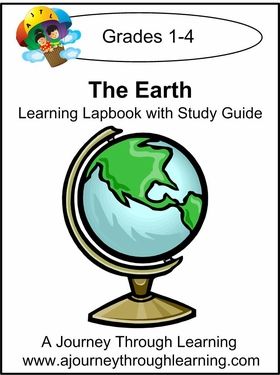
A Journey Through Learning Earth Lapbook - REVIEW


A Journey Through Learning Lapbooks was created by Paula & Nancy.  They are two homeschooling moms who wanted quality hands on items for their children as they were teaching them at home.  They knew that this was an area that was lacking in homeschooling materials.  Between them both they have 6 children.  Where would they get the time to create something?  Let alone run a business.  Well they started with Unit Studies and it blossomed into lapbooks.  To read more about their story click here.


So if you are new to homeschooling, you may be wondering, "What is a lapbook?"  Don't let that term scare you away.  It's really quite simple and fun!  A lapbook is where you use manila folders (we use both regular and legal size in our projects).  Most lapbooks come in the e-file format though I have seen ones pre-printed.  You cut out the different information sections, fill them out as you read books, the information provided with the lapbook, watch videos on the web, and add whatever else you like!  Really quite simple. 

We were introduce to lapbooks about 3 years ago through another review program.  At first it seems intimidating, but it really is quite easy to do.  The Library becomes your best friend (if it isn't already).  We really love lapbooking.  It's such a creative way to do a unit study.  You can make the amount of time spent on it as short or as long as you want.  I try to spend at least 2 - 3 weeks on a lapbook.  This way I feel like my children are learning about the topic studied.  The AJTL lapbooks can take 2-4 weeks.  But really how much time you want to spend on it is what you determine. 

I love the vast amount of topics that are offered in lapbooks.  It seems that there is one for everything!  A Journey Through Learning offers SO many different ones!  They have lapbooks for Apologia Science curriculum you may be using.  There are also ones for holidays, history, Classical Conversations and so much more!

We worked on the lapbook for The Earth.  It is for 1st - 4th grades.  Now, you may be thinking, "your kids are in 5th and k grades".  This is very true.  But by using books appropriate for their level of understanding I made it more for their grade level. 

In the lapbook is a list of suggested books for you to read with your children or them to read alone if they are able to do so.  I chose a few of the ones listed in the lapbook and also chose a few others that were grade appropriate for my boys. 

Most of the books were read aloud and because there was a good bit of information already put into the lapbook so we read that aloud as well.  We learned about the layers of the earth, seasons, days and how time is calculated, the layers of atmosphere, topographical features (though I didn't use that term with the kids).  We really covered quite a bit.  So much so that I spread it out over several days for the boys.

We also have a set of mini encyclopedia style books that we use to help in our Earth research.  Since Jonathan is in 5th grade, I felt it appropriate for him to do some more research on his own.  I really try to use the internet for research.  This is because he could spend HOURS on there.  I prefer him to use books and use the skills of research in the Library.

Now I am one of those moms who makes sure all the reading is done first and then we work on the lapbook.  I get too discombobulated when I try to work on the lapbook and do the reading at the same time.  So we worked on our lapbook and got it put together in a day.  Now, that did not include Jonathan filling in all of the information. 

One thing I didn't think about till afterward was that I should have had him at least filling out the pages as I was reading the books/lapbook pages or researching.  Instead he did all that afterward and while it worked out, he got frustrated at points cause he had to go back and find the answers again.  So maybe take that little bit of info as a tip for what not to do and what might be best.

Also, in this lapbook they had poetry and songs to go along with the Earth topic.  That was so nice to incorporate into our learning experience. 


Overall we really enjoyed our Journey Through Learning Lapbook experience.  It is nice to see the quality and information provided by AJTL in their lapbooks.  I can't wait to try more.  We currently use Apologia Science so I am going to get the one that corresponds to the program we are working through.  :)

The lapbooks vary in price, but here is the pricing for The Earth.
Instant Download - $13.00
Printed - $21.00

You can get your other materials at office supply stores.  Something else I plan on doing with my next one is to use some of my scrapbooking supplies in making the lapbook!  I think that will add even more creative elements to the lapbooking experience.


Photobucket


 photo DisclaimerGraphic1_zpsf612f371.gif
Read More

TouchMath


TouchMath was started by Janet Bullock about 30 years ago.  She was an elementary school teacher and was looking for a way to guide her students through learning math.  She knew that learning math was not only hard, but it could also leave a child feeling low about themselves.  Read more of the story about Touch Math here.

With our first son, Jonathan, we used a traditional text book approach to teach math.  I began homeschooling him in Kindergarten and that style suited his learning personality.

When it came to teaching our 2nd son, Jordan, I knew from reading all the books about learning styles that I wouldn't be using the same approach.  As we came closer to the beginning of the school year, I was still at a loss on how to teach him so we would go over number flash cards, sequencing and such. 

So the opportunity to review the TouchMath Kindergarten program came up and when I saw it I just had a feeling that it would fit Jordan's learning style.  So naturally we stalk the mail/ups/fedex guy after we knew the product has been shipped.  It's like Christmas when new curriculum arrives at our house! 


I received the e-mail with the Kindergarten Modules and teacher info and immediately started to read it.  (There is quite a bit of reading to do, but well worth it)

Each Module covers different sections of math learning.  Module 1 covers Counting, Adding, Subtracting within 5.  Module 2 covers Adding & Subtracting within 9.  Module 3 covers Understanding numbers 1-20.  Module 4 covers Measurement, Data & Geometry.  We decided to go ahead and start at the beginning to make sure we had everything covered. 

So now we waited for the manipulatives that TouchMath was sending us to use and I printed up the first Module.  **Cue Final Jeopardy Theme**  Then the box arrived!

It was filled with all sorts of manipulatives!  We received the 3D Numerals, the TouchMath Kindergarten Tutor Software & the TouchMath TouchShapes.  Again, this was like Christmas for Jordan. 

He was SO excited that he wanted to start that day, but I wasn't ready yet.  I wanted to make sure I understood how to use the manipulatives.  (There is great training online to use here)  So I spent about an hour reviewing the videos and preparing myself for the next day.

To say that Jordan was excited to start his math would be an understatement.  I got Jonathan set up with his math and had Jordan (and Josef) sit down with me as we opened up the 3D Numerals and learned about Touch Points.  The boys loved it.  Even my youngest son (who is 3) enjoyed the 3D Numerals.

Touch Points are a unique way of learning to count and also learn the numerals.  If you can see in the picture of Jordan holding them, each numeral has a dot or point on them.  The videos on the training teach you (the parent) how to show your child how to count them so they can learn to add (using 2 different ways with the touch points).  For example Numeral 3 has 3 points.  You count each point once.  Now when you get to Numerals 6-9 it may look tricky but as you look closely, you will see a ring around the Touch Point.  This means you count that point twice.  Now, when I first got these out, I was confused and didn't know what to do so that is why we waited a day so I could go through the training!  It's free and online at the TouchMath Website (listed above).

The Touch Points are a great way for the hands-on child to learn their numerals and be able to count and add quickly.  He caught on so fast and I was really pleased with it.  There is also a CD with the 3D numerals that has printable worksheets to help reinforce the learning of the Touch Points.  We have used these several times.


We spent about 5 minutes working on our Touch Points then I had Jordan work on a couple of worksheets.  You really only spend about double there age in time.  This is good because they don't get burned out.  However, if you have a child who loves manipulatives and working on papers then it may not be enough.  We often spent more time because Jordan wanted to keep going!  (but really never more than 20minutes)

About 2 weeks into the program, I decided to let him go ahead and use the Tutor Software.  It wasn't called for yet in the curriculum, but Jordan was choping at the bit to use it!  (He is a techy person like his father & I)  This was another success and I let him use the software for at least 15-20 minutes.  (mainly because I forgot to set a timer and he was enjoying himself so much)

The software is great not just for math, but learning the states.  You click on a state to do the activities there.  I really liked that part.  Jordan just loved being on the computer doing math.  I really had to make sure that he didn't over-do it with the time.  I didn't want him to get burned out in any way.  (but it doesn't appear that he will at this point)

Jordan is such a hands-on kid that this curriculum is a great fit for us.  He grasps the concepts fairly quickly and seems to be retaining them well too.  He loves the manipulatives.  They really are a great addition!  That said, the manipulatives aren't absolutely necessary to utilize the program.  The program itself is complete as it is.  But I felt that Jordan grasps things better with manipulatives.  So, depending on your child's learning style you may or may not need the manipulatives. 

I really like this program.  The Touch Points really make it unique.  It is great for the child who needs a more hands-on approach.  Even without the manipulatives you can teach Touch Points (this is shown in the video training).  I like how it is broken out in to modules versus the child seeing a text book that can be overwhelming.  Not that textbooks aren't good, but it's nice to be able to print out what you need for your child.  They don't see how much is left and feel like they can't do it.  Jordan would not do well with the textbook style at all. 

I am really glad we were able to review this product. We will continue to use it through Kindergarten so he gets a strong base in math. I will also be using it with Josef as well since it seems that he has the same learning style as Jordan. Plus he seems to be grasping some of the concepts we are doing already.

TouchMath Kindergarten for Homeschoolers is broken up into 4 separate units.  Each Unit covers something different.  You can see where your child is and start in the appropriate unit.  That is one of the really nice things about TouchMath.

So how much does this curriculum cost?
Each Module is $59.95.  You can get all four modules for $199.95.  That's a savings of nearly $40 dollars!

The Manipulatives that we received are priced as follows.
3D Numerals - $79.00
TouchMath Kindergarten Tutor Software - $99.00
Touch Shapes - $30.00


Photobucket

 photo DisclaimerGraphic1_zpsf612f371.gif
Read More

ARTistic Pursuits


At a very young age I knew my son, Jonathan, was interested in drawing.  He would draw on anything we gave him.  Thankfully he contained it to the mediums appropriate for drawing. 

As we began homeschooling I just let him draw whatever he wanted.  I never had a curriculum, nor could I find one that I liked enough to get him.  I wanted something to help enhance the natural talent that God gave him.  But I also wanted something to educate him in art.

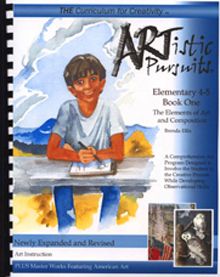
Enter the opportunity to review ARTistic Pursuits: Elementary 4-5 Book 1.  ARTistic Pursuits was developed and written by Brenda Ellis and Daniel D. Ellis.  They created this curriculum because they believe that children can understand the concepts of art and put them into practice.  To read more about the philosophy of ARTistic Pursuits click here.

In going through this curriculum, I felt that they really encouraged kids to think outside the box.  So much so that my son (who is kind of used to being told what to do) had a slight difficulty in the very beginning.  But as he read and I encouraged him, he was able to grasp the concepts that were being taught in the curriculum.

Jonathan and I would take 2 (sometimes 3) days a week to work on art.  He often begged to do it daily but I really needed to keep him on track to not rush through things.  He got so excited about art.  I think for a time before this he was getting rather bored with just drawing without direction.  But now with a guide at his fingertips he started to enjoy it again. 

We sat and read the lessons together and also enjoyed the American Artwork that was introduced in each lesson.  Sometimes we would move on to the activity, but sometimes I would have him research the artist studied and tell me about his life, some other paintings he did and basically give me an oral report.  I like to see that he is learning about artists as well as techniques.  Together we would spend 15-30 minutes and then I would let him work on his own for 30-45 minutes (or longer if he needed to).

I loved how after a couple of lessons he really began to broaden his perspective on things to draw.  He began this course drawing the same things over and over but toward the end of the review period he really opened up.  He even went to my refrigerator to get some vegetables to practice drawing.  That was a first!  I was SO excited to see him do that.  It really made me glad to see him change what he was concentrating on for drawing.

ARTistic Pursuits teaches focus.  Focusing on a certain aspect of drawing to really hone in on that skill.  I think that was one of the things that impressed me.  They didn't just say to draw an apple.  They have you looking at all aspects.  Outline, shadowing and detail to name a few. 

Overall, I am really pleased with ARTistic Pursuits.  I feel that my son does well with a lesson and then hands on application.  I also love the incorporation of American Art!  Definitely something I had been wanting to do and now I have the best of both worlds.

ARTistic Pursuits has curriculum from Preschool through Highschool.  From being able to use the 4-5 Book 1 with Jonathan, I definitely like what I see and feel that it is going to be in my family for quite some time.  I am already planning to get the books for my younger children. 

Something to note:  You do want to make sure you have the supplies listed.  I did go purchase some things for Jonathan as we didn't have certain types of erasers or pencils.  But these can be easily found on amazon.com or at your craft store.

To purchase ARTistic Pursuits 4-5 book 1 click here.  It is $47.95 and for ages 9+. 


Photobucket


 photo DisclaimerGraphic1_zpsf612f371.gif
Read More

Abraham's Journey - A Book Review


A dream is a wish your heart makes.  Or so the song says. 
The American Dream!  Now there's something for you to think about.  So how does one go on Inspiring the American Dream

My son and I were able to review the book Abraham's Journey: A Celebration of the American Dream.  When the American Dream seems lost, I was glad to see that it wasn't when we read this book together. 

Abraham's Journey was written by Kathleen Basmadjian & Robert Basmadjian Jr.  Kathleen has worked for the pharmaceutical industry in the public and private sector.  She also volunteered her time to mentoring and tutoring children in the DC area.  Robert has more than 15 years in the publishing industry.  He also has worked in advertising and public relations.  You can read more about the authors here.

Today it seems that all you hear is negativity.  What happened to the American Dream?  It seems so lost amongst all the things of this world.  It's not only going to affect the adults but it will affect our children as well. 

Reading Abraham's Journey was such a treat to see that the American Dream is still alive!  Abraham is a young boy who's father lost his job.  (Something I think we can relate to today)  It's approaching Christmas and he wants to get gifts for his family.  But he doesn't know how. 

So he is surfing on his phone and is led on a journey by President Lincoln.  They travel through the past and meet several historical figures along the way. 

As they go through the journey, Abraham discovers some things.  He discovers that to achieve the American Dream it takes hard work, dedication, faith, creativity and a persistent attitude. 

Those things are what we as parents need to instill in our children.  But we can't do it alone.  Everyone needs to be on board.  Parents, Teachers, anyone that has an influence over our children.  If we don't do this, there is a chance that the American Dream will be lost.

This book is beautifully illustrated and written so that it is easily understood.  My oldest son, Jonathan (10), read it as an assignment alone.  (it is geared toward ages 7-12)  Then I read it myself.  I also took the opportunity to read it aloud to my children and 3 children I am watching right now.  (ages 10-2)  They loved to look at the pictures.  I even found myself tearing up as I read it aloud to the children.  It is something that struck me as we go through these times.

The American Dream is defined as such.  The ideal that the American system of self-government allows for any and all individuals to pursue and achieve a fulfilling and successful life.  This is something I really want to have my children achieve.  My husband and I work really hard to instill the values necessary to achieve the dream.  So with a lot of prayer, faith, hard work, creativity, dedication and persistence, hopefully one day they can achieve  the American Dream. 

If you want to share the American Dream with your child, I highly recommend reading this book to your children.

Abraham's Journey: A Celebration of the American Dream is available here.  It is $14.99. 

Photobucket


 photo DisclaimerGraphic1_zpsf612f371.gif

Read More

College Common Sense - Going to College and Paying for it


My oldest son, Jonathan, is 10 years old.  Going on 11.  When we found out we were pregnant with him we looked into how much college was going to be to attend.  It was anywhere from $20k - $40k depending on where you were going.  And those were community colleges, mixed with some state colleges.  Now if you wanted a private or Ivy-League college you might as well double to tripple the hightest amount.  You could buy a house with what some colleges charge for tuition! 

So we had every intention of putting money aside for college as our children grew up, but we weren't the best in making financial decisions and that didn't happen.  Fast-forward almost 11 years and we have no idea how we are going to pay for college.  Plus the cost of college has gone sky high.  Even community college is expensive!

Needless to say we need some help!  We had trouble navigating financial aid as highschool students and even as adults wanting to further our education.  Enter College Common Sense and their product Going to College and Paying for it  (online video & workbook). 


College Common Sense and Going to College & Paying for it was created by Denise.  She works in the financial aid department and really knows what you need to know to get money for college.  Click here to view a short introduction by Denise.

Jonathan is going into 6th grade next year.  That means 6 short years from now he is going to be entering the world of college!  My heart goes faint and then screams at the thought of funding school! 

Jonathan and I would watch the videos together in the afternoons and go through the workbook together.  I found it very informative.  It told what YOU (as the student) need to do to prepare for college.  The 6 videos go over the following: The Big Picture, How Financial Aid Works, All About The Free Money, The System That Works, You in the Process, & Put it All Together.  She emphasizes that it is all up to YOU to work hard to get the money.  Whether it's scholarships, grants, loans, you have to do the work.  It's not something that just magically falls into place.

Another  thing we did was we signed up for the FREE lesson plans that Denise offers. These are great ways to involve your child. And even though Jonathan is only in 5th grade right now, I don't feel that it is too early to start preparing him to do things to save money for college. In the lesson plans, Denise suggests some videos to watch and activities for your child to do.

Each activity she suggests are age/grade appropriate. I liked how she suggested he make a spiral bound notebook called "all about me." He loves to draw and write so that was right up his alley. Denise suggests a different activity each week for you to work on. I highly recommend signing up for the free newletter with lesson plans.

I think at this point this might have gone over his head a little bit.  But I am glad we were able to do it as it let me know what all I need to help him do in preparing for college. It has been many years since I had done anything regarding college so this was a great refresher for me as well. 

Overall, I felt the program beneficial for us.  My son might not have realized it was beneficial, but I think as we go through it over the next 6 years he will.  He did start to ask questions about the videos and about the topics covered. I was glad he did that because it did show that he was paying attention.

I feel so strongly in my son being able to pay for his college that we will work together to get this accomplished as much as possible!  But not oly will I be working with him, as my other children come of age, we will do the same thing with them.

To purchase Going to College and Pay for it (online and workbook) click here.  It is $25 for 12-months of access.
There is also a DVD with the workbook option as well.  It is $50 + $5 S&H.

Photobucket


 photo DisclaimerGraphic1_zpsf612f371.gif
Read More

Handwriting Without Tears Kindergarten


Handwriting Without Tears was started in 1977 by Jan Olsen.  She wanted to help her son, John.  He was struggling to learn how to write.  Jan was an occupational therapist and used that training to help her son.  His teacher noticed the progress he was making and asked Jan to help others in their struggle with learning to write.  The remedies and strategies she developed are what we now know as Handwriting Without Tears.

The following is from the Handwriting Without Tears website.  At Handwriting Without Tears®, our mission is to make learning and teaching easy and fun by providing superior educational products, training, and materials to educators and parents.

When I started homeschooling my first son 6 years ago I used the same curriculum that was used to teach me to write.  For us it worked pretty well.  I figured we would be good to use the same curriculum with any other children we had in the future.

Enter Jordan Matthew Gideon.  He was born 5 years after our 1st son.  He also was the baby who was born when we started our adventure of homeschooling.  Little did we know what an active, sweet child he would be as he has grown up.  He turns 6 this May and also shares a birthday with his daddy. 

Something that I was not prepared for with him was the fact that he was going to be the child who would do things with his left hand.  He was about 2 years old when I discovered him doing more and more with his left hand. 

My dilemma had now become how to teach a child who does things with his left hand how to write.  And this was a problem because I am a right handed person.  I felt so ill-equipped to teach my son to write since he used a different hand than I did.  My husband is also a righty.  I even thought of sending him to my Mother-in-Law (she's a lefty) or to have a good friend of the family (another lefty) teach him how to write left-handed.

Over the 5 years he has been alive, we have invested in several things to help him write.  Toys, games, etc, but I still hadn't found a curriculum that I felt comfortable with to teach him how to write. 

When I saw that the Review Crew would have an opportunity to review the Handwriting Without Tears program I literally JUMPED with joy!  I had wanted to try it but things didn't work out.  Add to my joy when I saw my name on the list of those reviewing HWT K!!


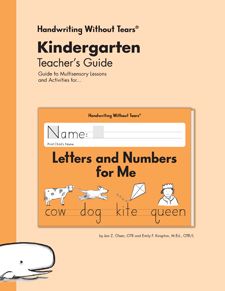
I received the Kindergarten program and Teachers Guide to use.  So the past few weeks we have been working through the curriculum.  It is great for a busy body like my Jordan.  The teachers guide has so many ideas to help your child.  But it isn't just about writing, it's more than that.  I have been teaching Jordan concepts that will help him grasp writing better.  And the past 4 weeks have seen such an improvement!  He is literally asking me to do the writing. 

Now you may be asking, is that all from just the books.  No, I did go to the Handwriting Without Tears website to purchase some select manipulatives that I felt Jordan would benefit from using.  We got the slate chalk board, the blue mat, the shapes (which if you want you can search for a template and make your own), and the sponge erasers.  I did not get the CD which has the songs that are recommended in the Teachers Guide.  However, since I play piano, we did sing several of them.  :)

When we start our writing class, I usually choose a couple of the Foundation Skills (found in the teachers guide).  Jordan loves the song "Where do you start your letters" and we typically sing that several times.  We vary it by singing loud, soft, jumping and sitting.  Then we use the shapes and mat to practice creating the letters.  We also use a foundation skill that teaches concepts such as above, below, behind, in front, up and down.  Jordan also loves making Mat Man.  :)  This is probably his favorite skill to practice. 


Then we start our writing portion.  He loves to get his pencil and sit and show me how he is writing.  It makes me smile to see him enjoy learning.  Especially since I was so worried about teaching him due to our differences. 

I think it is very important as a parent (and teacher to your child) to know your child and how they learn.  Not everything will work the same for every person.  But for us, Handwriting Without Tears has been quite the success!  So much so that I plan on using it through the next few years as he improves his handwriting. 

I am also planning on using it for our 3rd son, Josef, who is just as active and would enjoy the manipulatives and foundation skills as much as his brother.  He already shows an interest and joins in on the songs and concepts. 

Handwriting Without Tears is a great program for children.  I think it is really good for those who need the extra help with concepts and skills.  Those concepts that Jan used with her son really do work!  I highly recommend this program and it will be one we continue to use with our children. 

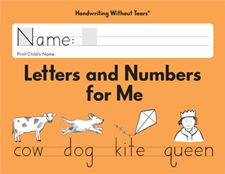
Handwriting Without Tears Samples

Student Book
Teachers Guide

Handwriting Without Tears Pricing
Student Book - $9.25
Teachers Guide - $8.25


Photobucket

 photo DisclaimerGraphic1_zpsf612f371.gif
Read More

Classical Academic Press - God's Great Covenant Old Testament Book 1


From the Classical Academic Press Website.  (Because they word it best!) 

Classical Academic Press is an educational publishing company located near Harrisburg, Pennsylvania. The Press is the product of years of brainstorming, conversations, thoughtful critiques and classroom application. Our mission is to produce and supply the finest classical curricula to the market today.

Our motto “Classical Subjects Creatively Taught”, describes the essence of all that we publish. We seek to produce classical curricula and media with a clear design and structure, incremental and systematic instruction, all with a touch of delight, creativity and flair.

One of the reasons my husband and I chose to homeschool was we wanted to make sure our children grew up knowing the Bible and developing a relationship with Christ.  It's not something we force, but we do make an effort to include Bible history, lessons and devotions in our school day.  We believe that God should be first and foremost in our lives.

Because of that, we try to choose curriculum that has Biblically sound values.  On one hand, you may think it is easy to choose a Bible curriculum.  But honestly, the job can be quite daunting.  I want something that my children can relate to so that they can understand it and absorb it rather than it be material to just memorize.


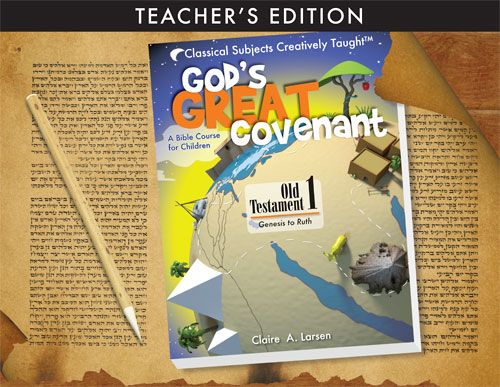
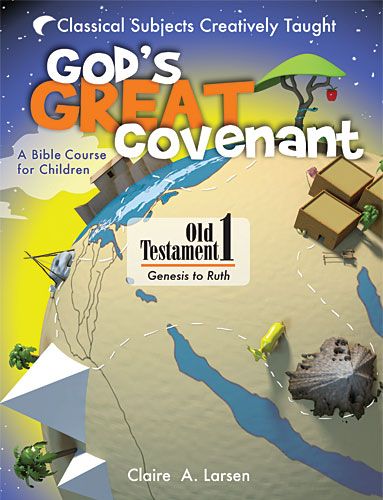
We received God's Great Covenant Old Testament (Book 1) Student Book and Teacher's Edition to use over the past month.  It is geared toward the middle grades (3-6) which was perfect for Jonathan who is in 5th grade

Within God's Great Covenant are 5 units and 32 chapters in the book.  I like how it is completed in almost a 36 week school period!  This is good for those of us (raises hand) who like to plan our weeks ahead of time and work in vacations.  Each chapter has 4 sections. The Memory Page, Story Time, Worksheets & finally the Quiz.

The Memory page is the first page you come to in your chapter.  It has the lesson scope, theme, memory verse, key facts, things to remember, who is God & read to me (where you read a related chapter of the Bible).  I had Jonathan copy this page down on day 1.  I think that writing something down helps you to retain it better and it has proven to be the case with him.  We also repeated the memory verse together several times the first day and also throughout the week.  I did make Jonathan read the assigned chapters in the read to me section on his own and come to me with any questions.

The Story page (well technically 2 pages) is something I actually read aloud to all the kids.  It is easy enough to understand and if they asked any questions, I would stop and answer.  I like to read aloud to the kids whenever I can and this provides a great opportunity.  Something else the story does is it ties in Jesus to the Old Testament.  It's not too often that you can actually see Jesus mentioned in the OT but regardless, He is there.  What a wonderful way to show your child that and I LOVE how CAP ties that aspect in to the lesson.

The Review Sheets & Quiz are pretty self explanatory.  However,I did have Jonathan re-read the memory and story before he did the review sheets.  For the quiz, I made sure he did the same things as with the review sheets and also reviewed those as well.  The quiz is a great way to see how much your student has retained.  Jonathan did fairly well with his review sheets and quizzes.


Something else I received was the Audio files of the stories.  This is a great addition if you choose to not read them aloud.  They are read by Christopher Perrin.  When Jonathan was told to review the story for his sheets and quiz, I would have him listen to these recordings.  I also put them on the iPod used at bedtime so all the boys (who share a room) could listen to them at night.  :)

I really like how God's Great Covenant is put together.  It doesn't overwhelm the child and if you want to, you can add things to make it more challenging or make it a little bit easier for younger children.  My boys are 10, 5 and 3 and I was able to use it with all of them easily.  For the younger two, I asked questions after we read the story which acted like our quiz/review.

Jonathan really seemed to enjoy the story part and he is asking to read more of his Bible now.  I can definitely see the impact it has had on him in this short period of time.  But something else that has been slightly unexpected is what I am learning as well.  I am enjoying going through this with Jonathan and I am already planning on purchasing the 2nd book for next year. 

We did this with our Bible History class so to separate out the time for GGC would be about 20-30 minutes.  It can definitely be lengthened or shortened depending on the student.  We did this as one of the first things in our morning.  It really helps to set the tone for the day when we focus first on God's Word.

If you would like to take a peek at the God's Great Covenant Old Testament (Book 1) feel free to look at the links below.


Curriculum Cost:
God's Great Covenant OT 1 - $22.95
Teachers Edition - $24.95 (this includes the entire student text with answer key and additional points that may prove helpful in teaching)
Audio Files - $9.95 (these are great to burn on CD or put on your MP3 Player)


Photobucket


Disclaimer:  I received a free copy of this product through the Schoolhouse Review Crew in exchange for my honest review. I was not required to write a positive review nor was I compensated in any other way. All opinions I have expressed are my own or those of my family. I am disclosing this in accordance with the FTC Regulations.
Read More